


David Ogilvy built a career on a single conviction: advertising exists to sell something, and you should be able to prove that it did. He came up writing mail-order copy, and he never stopped saying it was the best training he ever got. Direct response was the one corner of the business where results were not a matter of taste. You mailed the piece, counted the coupons that came back and the number was the number. No amount of creative self-regard could argue with it. He spent the back half of his career frustrated that the rest of the industry treated this as beneath them, when it was the only part of advertising that told the truth.
What Ogilvy wanted was an honest line between the thing you did and the result it produced. In his era you could draw that line, because the system was small enough to see end to end. There was one catalogue, one offer and one traceable action. The feedback was slow, and the data was thin, but it was real. When the orders came in, you knew what had produced them.
Digital advertising was supposed to be that dream realized at a scale Ogilvy never could have imagined. Not just the coupon, but the whole journey. Every ad seen, every link clicked, every path a stranger took from a first impression to a purchase, captured and counted and assembled into a complete picture of cause and effect. The promise was precision. After a century of guessing which half of the budget was wasted, we would finally know.
We did not finally know. We built something far more sophisticated than Ogilvy’s coupon and ended up further from the truth than he ever was.
Promises, promises
The discipline that was supposed to deliver Ogilvy’s dream is multi-touch attribution. The idea is straightforward enough to explain at a dinner party. A customer rarely buys after a single interaction. She sees a video, ignores it. Sees a display ad three days later, ignores that too. Searches your category, clicks a competitor, comes back a week later through a paid search ad, signs up for a newsletter, and converts a month after that off an email. Multi-touch attribution promises to reconstruct that whole sequence and assign credit fairly across every touch, so you know what actually moved her along the decision path.
It’s a beautiful idea but in practice it’s closer to astrology than accounting.
The first problem is that the data telling you this story is not yours. It’s computed and reported by the platforms that sold you the advertising in the first place. The same company that takes your money also grades its own performance and hands you the report card.
Meta tells you how many conversions Meta drove. Google tells you how many conversions Google drove. Each of them, asked about the same customer, will happily claim her. Run the numbers across all your channels and you routinely find you have paid for more advertising than your actual sales. Everyone takes credit. Nobody is lying, exactly. They are each answering a slightly different question, using a model they designed, measuring a window they chose, and they are under no obligation to reconcile their answer with anyone else’s.
This is not a story about bad vendors or sloppy implementation. The walled gardens don’t share data with each other because sharing it would dissolve the thing that makes each of them indispensable. Apple’s tracking changes in 2021 didn’t break attribution because Apple was careless; they broke it because the cross-platform visibility attribution depended on was borrowed, not owned, and it could be revoked the moment a more powerful player decided its own interests ran the other way. The precision was conditional and the values were not aligned.
The house computes the odds
Most complaints about attribution end with a wish that the platforms would behave better but that doesn’t dig deep enough. The platforms are not behaving badly. They are behaving rationally and in their own best interests.
Picture what it would mean for a platform to give you genuinely clean attribution. You would learn, with confidence, which of your spend produced results and which produced nothing. You would cut “the nothing”. Your budget would shrink, or move to wherever the truth pointed, which might be away from that platform entirely. Clean attribution is, from the platform’s perspective, a tool for helping you spend less with them. No rational business builds that tool and points it at its own revenue.
What a platform wants instead is for you to keep playing. Not to lose — a player who only loses eventually walks away – but to win just often enough, that you can never quite tell whether the wins came from your skill, the platform’s algorithm, or the simple fact that you kept feeding the machine. The optimal state for the house is a player who is convinced the game is winnable and can never prove whether they are winning. That player spends forever.
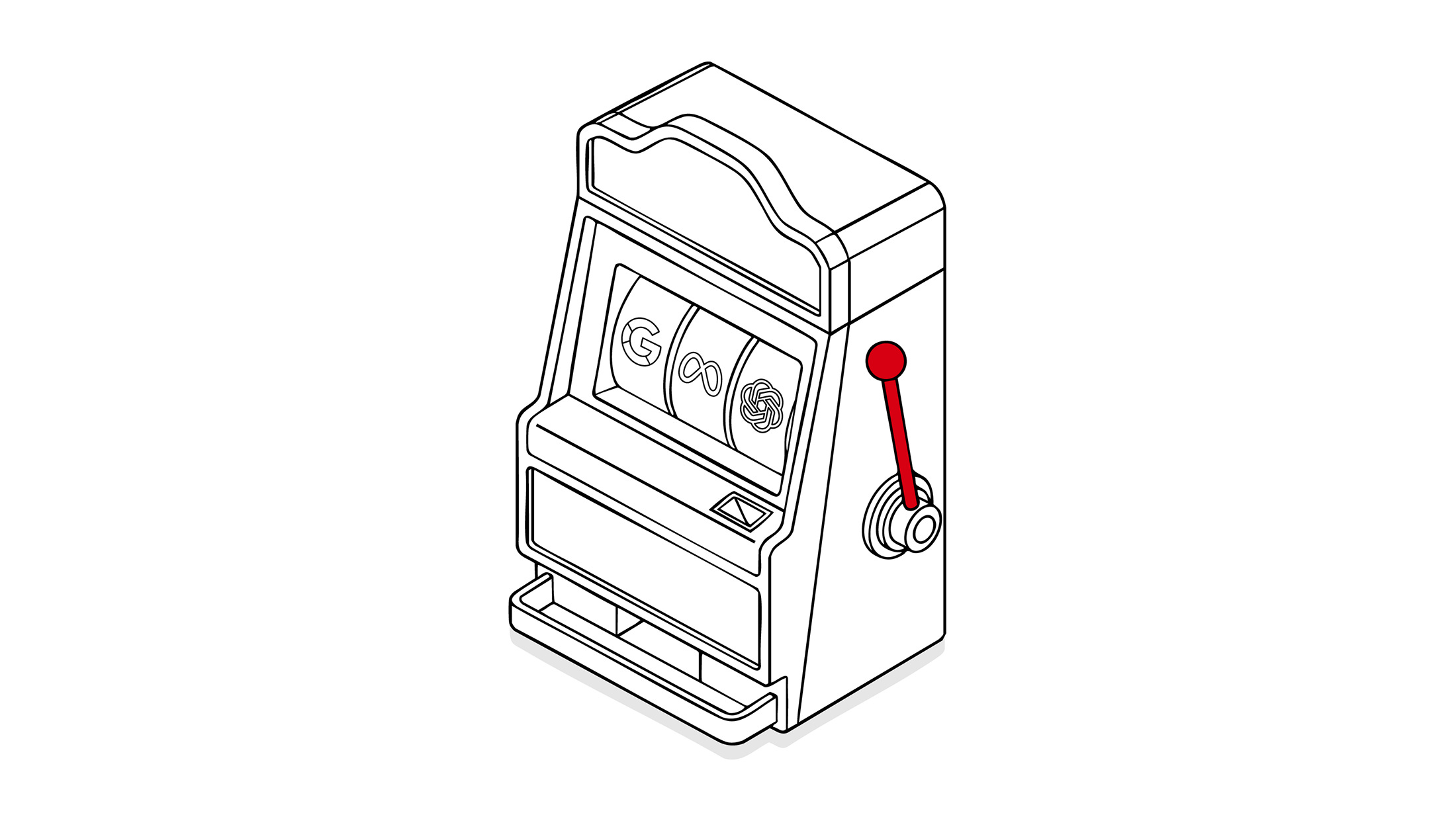
This is the attribution casino. The fog is the product. The entire industry of attribution software benefits from the confusion, selling maps to a floor that the house keeps rearranging. The platforms just want to keep you in the building, looking for the exit, certain that the right tool is one purchase away.
None of this requires a conspiracy. It only requires that everyone act in their own interest, which is the one thing you can always count on a market to do. That is what makes it durable. You can’t appeal to anyone’s conscience, because no one is doing anything wrong. The system is working exactly as designed. It’s just not designed for you.
AI is the casino’s final form
For all its opacity, the old casino at least let you see the floor. Google built an empire on paid search, but it ran alongside an organic search product that people had reasons to trust, and that tension forced a certain amount of visibility into the open. You could see the search results. You could track your keyword rankings, watch your position move, measure click-through, study the volume on a term and decide whether to fight for it. The instrumentation was imperfect and the game was rigged in the house’s favor, but there was a game board, and you could study it. You could become a better player.
Watch what happens to that game board when discovery moves into AI.
Start with what’s already here, because this is no longer a forecast. In February 2026, OpenAI began placing ads inside ChatGPT — sponsored units rendered beneath the AI’s answer, matched not to keywords but to the context of your conversation, sold at premiums that dwarf ordinary display because the intent is so concentrated. By spring, any advertiser in the United States could buy them through a self-serve dashboard with no minimum spend. Google moved the same direction faster: ads now appear inside a quarter of its AI-generated answers, up from roughly one in twenty a year earlier. The migration of paid advertising into the answer itself has already happened. We are simply early in it.
Now follow where it goes. Optimizing for AI answers — answer engine optimization — is becoming the new search marketing. But the equivalent of the old game board doesn’t exist. There is no ranking report for an AI answer. There is no position to track, no search volume to study, no result page to inspect and reverse-engineer. The answer simply appears, fully formed, and you have no way to audit why it recommended a competitor instead of you, or whether the recommendation was earned or bought. You can produce content and hope the model references it but you can’t see whether it worked, because the surface where it would have shown is a black box with no dial on the front.
Then there’s the part the structural logic makes inevitable, whatever any individual company says today. The economics of frontier AI are brutal — the leading labs are burning capital at a rate that demands a revenue engine, and advertising is the most profitable engine ever built. Forecasts already put AI search ad spend on a path from around a billion dollars to roughly twenty-six billion within a few years. Not every player will go there. Perplexity, tellingly, abandoned advertising entirely in early 2026 and is betting it can win as the trustworthy, ad-free alternative — a bet that is itself an admission that ads and trust pull against each other. But that is a bet by a challenger trying to differentiate, made against the full gravity of the market. The dominant economics point the other way.
What makes the AI casino even worse is that you now pay to enter. In the old model, your attention was the product and you paid nothing at the door. In the AI model, you pay for the answer — in subscriptions, tokens, the metered cost of every query — and your attention is still being sold. The casino now charges a cover and takes a cut of every hand. Wait! There’s one more turn of the screw. OpenAI has said it will launch its own multi-touch attribution product, a tool to show advertisers the customer journey across ChatGPT and beyond. So the same logic that made platform-reported attribution untrustworthy for fifteen years is being rebuilt, from scratch, inside the most opaque discovery system anyone has yet devised, but not to worry, it’ll be sold back to you as clarity.
What to do with this
I’d like to end with a playbook but I don’t have one, and I’m suspicious of anyone who does.
The honest position is that the game is moving faster than our ability to map it. The old attribution game took fifteen years to understand, and we never really got it, we just learned to live with the lies.
So this is not a piece with a prescription. It’s a piece with a question, and the question is the most valuable instrument you can carry into the next decade of marketing. Every time someone hands you an attribution number ask the only question that matters: who computed this, and what did they want when they did?
That question won’t necessarily lead to clarity but it replaces false precision with earned skepticism, and in a casino, the skeptical player is the only one who keeps their shirt. There isn’t a lack of data. You’re drowning in data. The danger is that you will mistake the house’s scorekeeping for the truth.
Ogilvy wanted to know, plainly and provably, what worked. We built a machine of staggering sophistication, pointed it at his exact question, then engineered it deliberately, rationally, profitably, to make sure the answer would always stay just out of reach.

It always felt inevitable that AI eats search, which means the advertising market that search served would move to AI and be capitalized (this is a major way the AI frontier labs are pitching investors on how they will make a return on their investment). The water on attribution is just getting murkier which isn't a good thing for businesses paying to advertise
So good! House always wins AND you have pay to pay a cover? You will not find me at this casino 😅