



When Stripe announced in August that it was acquiring OpenRouter, the general reaction to it was two-fold:
First: “yeah, that makes logical sense.”
Followed by: “whoa, that’s a hefty valuation!”
The exact price hasn’t been disclosed, but reports put it above $7 billion. OpenRouter had been valued at around $1.3 billion only a few months earlier, so that’s a pretty big jump in a pretty short amount of time.
It raises a simple question: why would a payments company pay that much for an AI model router?
The easy answer is AI infrastructure. OpenRouter is growing incredibly fast, AI spend is growing incredibly fast, and everybody wants a position somewhere in the stack.
But there’s another way to look at it. Stripe’s own stated mission is to increase the GDP of the internet, which is a much broader mandate than processing payments. It puts Stripe in the business of expanding economic activity online and building the infrastructure around it.
OpenRouter fits pretty naturally once you look at Stripe that way.
Routing the internet
Here’s the simplest way I’ve been thinking about it.
Google routes information based on relevance, Amazon routes goods based on demand, Stripe routes economic value through transactions, and OpenRouter routes AI requests based on cost, performance, latency and availability.
They’re very different businesses, but each grew outward from a fairly narrow starting point. Google started with search and became infrastructure for organizing information. Amazon started with books and built systems for moving goods, then became infrastructure for computing. Stripe started by making credit card payments easier online and has spent the last 15-plus years expanding the ways value can move across the internet.
AI adds another kind of economic activity to that system, and it comes with its own unit: the token.
The second currency
I’ve been calling tokens a second currency, which requires a little qualification.
An AI token isn’t a dollar or a cryptocurrency. You can’t put 50,000 Claude tokens in your wallet and go buy groceries. Tokens are closer to a meter for computational work. Make an API request and the model consumes tokens; different models charge different rates, and providers compete on price, speed and capability. Eventually all of that usage gets translated back into money.
So now you have two measurements running alongside each other: money tells you what the work costs, while tokens tell you how much computational work was consumed.
That changes the grain of economic activity inside software. For most of the internet’s history, the things we paid for were relatively chunky: a purchase, a subscription, an invoice, a transfer. One action inside an AI application can now trigger several models, tools, retries and fallbacks, consuming thousands or millions of tokens along the way.
The user experiences one action, but under the hood, there may be dozens or hundreds of measurable events, each with a cost attached to it.
Once those events can be measured, they can also be priced, billed, optimized and routed. Then somebody has to handle the money around them.
Stripe has been putting together a lot of those pieces.
Look at the last few years
Start with Bridge. Stripe bought it for roughly $1.1 billion to expand its stablecoin infrastructure: issuance, custody and moving between fiat and digital dollars.
Then came Privy, which provides programmable wallets embedded directly into applications, and Tempo, the payments-focused blockchain Stripe incubated with Paradigm for fast settlement and stablecoin payments.
Metronome added usage-based billing and real-time metering. Patrick Collison described metered pricing at the time as the “native business model for the AI era,” and later described metering and billing as the interface between product and business.
Now OpenRouter adds another layer: a system sitting between developers and hundreds of AI models, deciding where requests should go based on economics and performance.
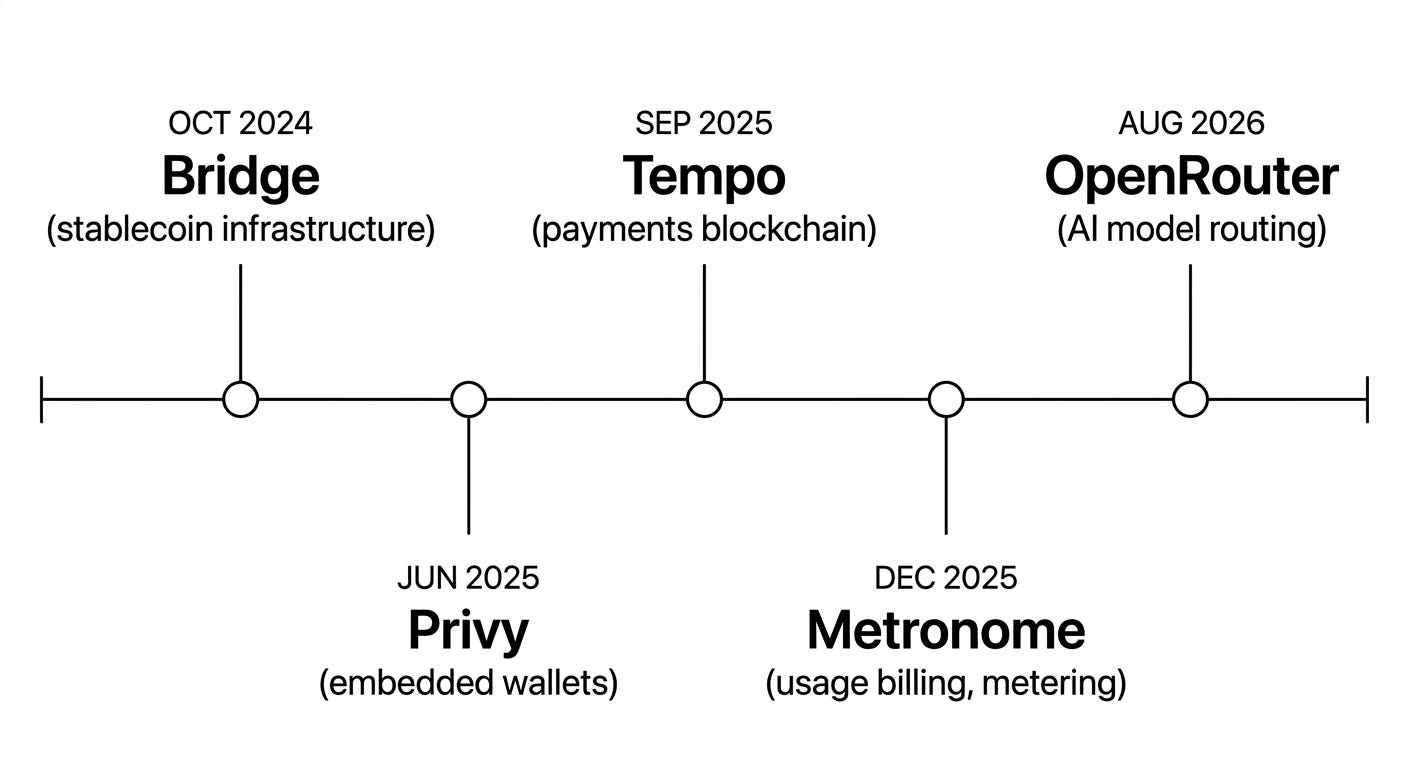
I wouldn’t read that as proof Stripe drew this exact roadmap five years ago. Much of its stablecoin strategy was already public, while the connection between stablecoins, usage billing and AI routing becomes clearer in hindsight. Taken together, though, the pieces cover a surprising amount of the same economic loop: measure the usage, route it, bill for it, move the money and settle it.
Pretty close to home for Stripe.
So why pay that much?
There’s still a fair question here: how hard is OpenRouter to reproduce?
The routing software itself doesn’t seem especially hard to copy. Databricks has built routing capabilities, Ramp launched a router, LiteLLM is open source, and large companies can build their own internal systems. OpenRouter even points some high-spend customers toward self-hosting.
The more valuable part may be the position it already occupies.
OpenRouter sits inside a huge flow of AI consumption. It sees which models developers choose, what they cost, where they fail, which providers are fast, when users fall back to something else, and how model share and price/performance change over time. It also gives developers one easy entry point into a fragmented market of hundreds of models and providers.
You can reproduce routing software faster than you can reproduce that flow. The position gets particularly interesting and more valuable when you connect it to Stripe’s distribution and financial infrastructure.
That starts to explain the price a little better - Stripe may be valuing where OpenRouter sits in the market as much as the product itself.
Office Space and fractions of pennies
There’s a joke in Office Space (great movie) where the characters write software to skim tiny fractions of pennies from financial transactions. A fraction of a penny doesn’t feel like much until you repeat it enough times.
AI pushes software economics toward that kind of scale. A token can represent a microscopic amount of money, while aggregate usage can reach trillions upon trillions of tokens. OpenRouter-origin data showed weekly usage above 100 trillion tokens by September 2026. That number needs some context. Reasoning tokens inflate the headline, and token growth isn’t the same thing as revenue growth. Still, it gives you some sense of the amount of activity passing through these systems.
OpenRouter handles that activity through prepaid credits. It meters usage continuously and deducts against a balance rather than settling a new financial transaction every time a token is consumed.
Stripe is working on the settlement side elsewhere. Tempo, its support for x402, and its machine-payment work are designed around much smaller, faster digital payments.
This is where the “second currency” idea starts to click. Tokens measure the computational work and money settles the value of that work. Stripe is building infrastructure around the connection between the two.
A bigger bet on internet commerce
Whether OpenRouter ultimately proves to be worth $7 billion is hard to know. The deal is more useful as a clue to how Stripe sees internet commerce developing.
AI is becoming embedded in normal software workflows, which makes model usage a real cost line inside those products. Requests have to be routed, usage measured, customers billed and money moved.
Stripe benefits as more of that activity becomes measurable and easier to transact. That fits pretty neatly with their “increase the GDP of the internet” mission.
Creating more commerce is one way to increase internet GDP. Another is giving economic activity that used to be hard to measure or price the infrastructure required to participate in commerce at all.
Stripe did that with online payments. AI is creating another large layer of economic activity underneath the software we use every day, and OpenRouter puts Stripe directly in its path.
There’s a useful way to look at other acquisitions through the same lens. Start with the underlying activity a company has spent years organizing, rather than the product that made it famous, then look for new versions of that activity.
For Stripe, card payments were one major expression of the opportunity. The next could happen at a much smaller unit size, far higher frequency, and increasingly between pieces of software.
OpenRouter gives Stripe a major place in that flow.
Share this with someone who still thinks Stripe is just a payments company.